Jerry Bergonzi Inside Improvisation Vol. 6: Developing a Jazz Language
Read Bergonzi Vol. 6 as a focused practice system for turning devices into personal vocabulary through listening, variation, transcription, repertoire, and deliberate limitation.
Published Jun 13, 2026, 9:00 AM
Read Bergonzi Vol. 6 as a focused practice system for turning devices into personal vocabulary through listening, variation, transcription, repertoire, and deliberate limitation.
Inside Improvisation Series, Vol. 6: Developing a Jazz Language belongs in a major music bookshelf because it changes how a practicing musician names problems. This JolyBook note reads the book as a working source: what it asks the ear to notice, what it gives the hand to practice, and where the idea needs careful interpretation.
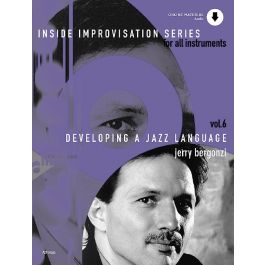
Why this book matters
Inside Improvisation Series, Vol. 6: Developing a Jazz Language belongs in the JolyBook shelf because it isolates one improvisational problem and gives the player a repeatable way to work on it. Bergonzi does not treat vocabulary as decoration. The material is meant to become a behavior: something the ear recognizes, the body can execute, and the player can vary under musical pressure.
The central focus of this volume is turning devices into personal vocabulary through listening, variation, transcription, repertoire, and deliberate limitation. That focus is narrow in the best sense. A musician can practice one device deeply enough to hear where it works, where it becomes mechanical, and how it can be transformed into phrase material.
The larger lesson across the Inside Improvisation series is disciplined limitation. Instead of trying to learn every possible jazz idea at once, each volume gives the player a smaller laboratory. The player studies a device, moves it through keys and progressions, then tests whether it can survive inside repertoire without sounding pasted on.
How to practice the idea
Pick one device, trace it in a recording, write three personal variations, then use only those variations over a chorus.
- Choose one language habit exercise and sing it without the instrument.
- Play it in four keys at a tempo slow enough to control articulation and time feel.
- Write the same idea over ii-V-I, minor ii-V-i, and a static modal vamp.
- Create three variations: one rhythmic, one intervallic, and one register-based.
- Improvise a chorus using the idea only twice, then leave space so the line sounds chosen rather than automatic.
Analysis frame
| Focus | What to hear | Practice decision |
|---|---|---|
| Source | Language begins with heard models. | Transcribe a short phrase before abstracting the device. |
| Variation | A device becomes personal through controlled change. | Rewrite rhythm, range, and ending separately. |
| Repertoire | Vocabulary must survive a tune form. | Apply the idea to blues, rhythm changes, and a ballad. |
| Identity | Language is selection as much as accumulation. | Keep the devices that fit your sound. |
Core takeaways
| Reading focus | Practical takeaway |
|---|---|
| Listening | Personal language starts from deep contact with recordings. |
| Limits | Restricting material forces invention. |
| Application | A device is learned when it appears naturally in repertoire. |
| Voice | Style emerges from what you keep, not everything you know. |
Interactive examples
Reading caution
Bergonzi practice becomes shallow when the device is played as a pattern dump. Every exercise has to return to time feel, phrase shape, harmonic aim, and personal sound.